Digital immune cybernetics
The agentic enterprise needs an immune system
How to design AI agents that can act without concentrating trust: identity, least privilege, containment, oversight, and recovery.
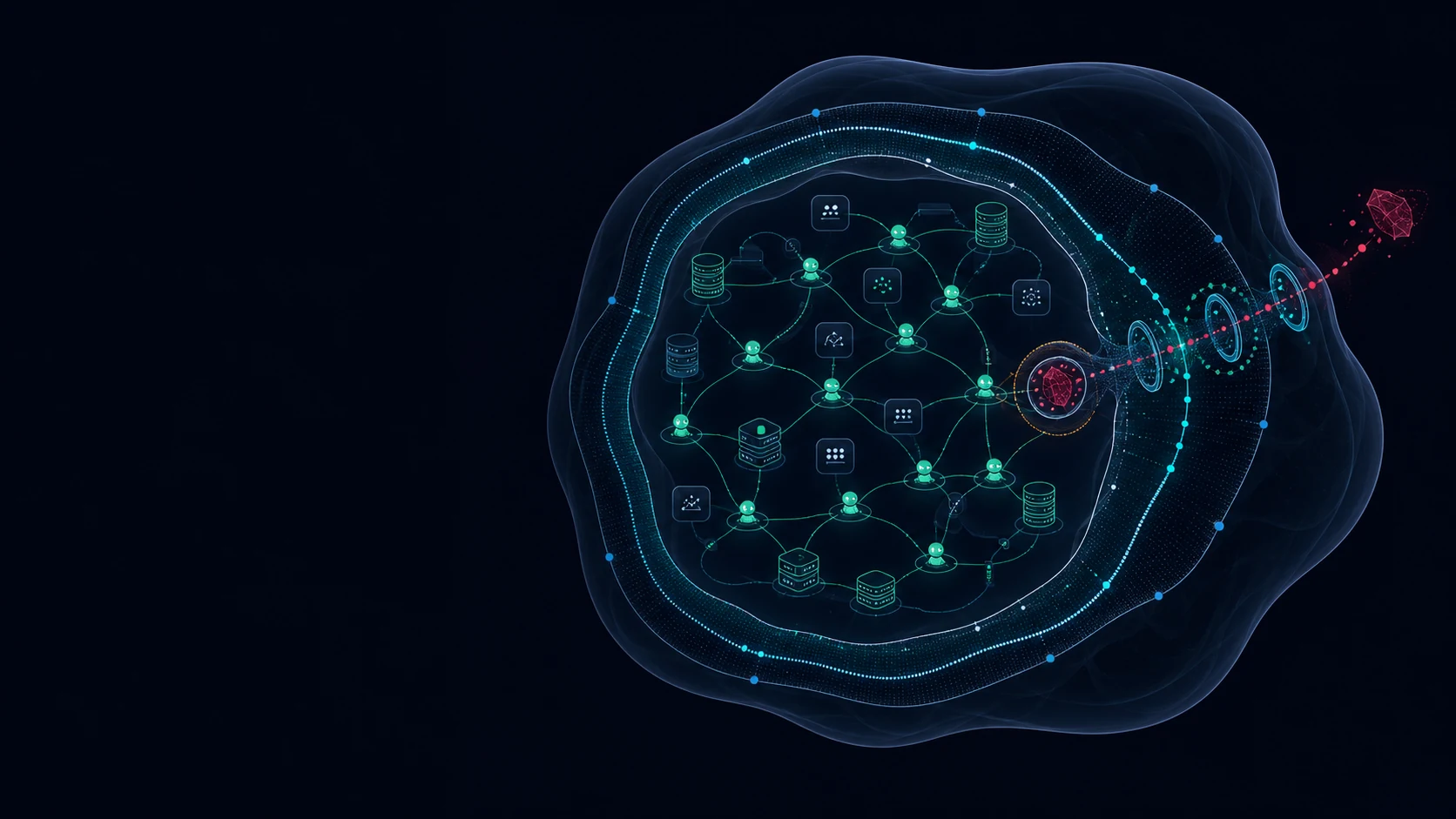
AI agents turn instructions into actions. Governing them therefore requires more than filtering what they say: we must limit what they can do, detect when they drift, and contain harm before it spreads. The security unit is no longer the isolated model, but the complete harness.
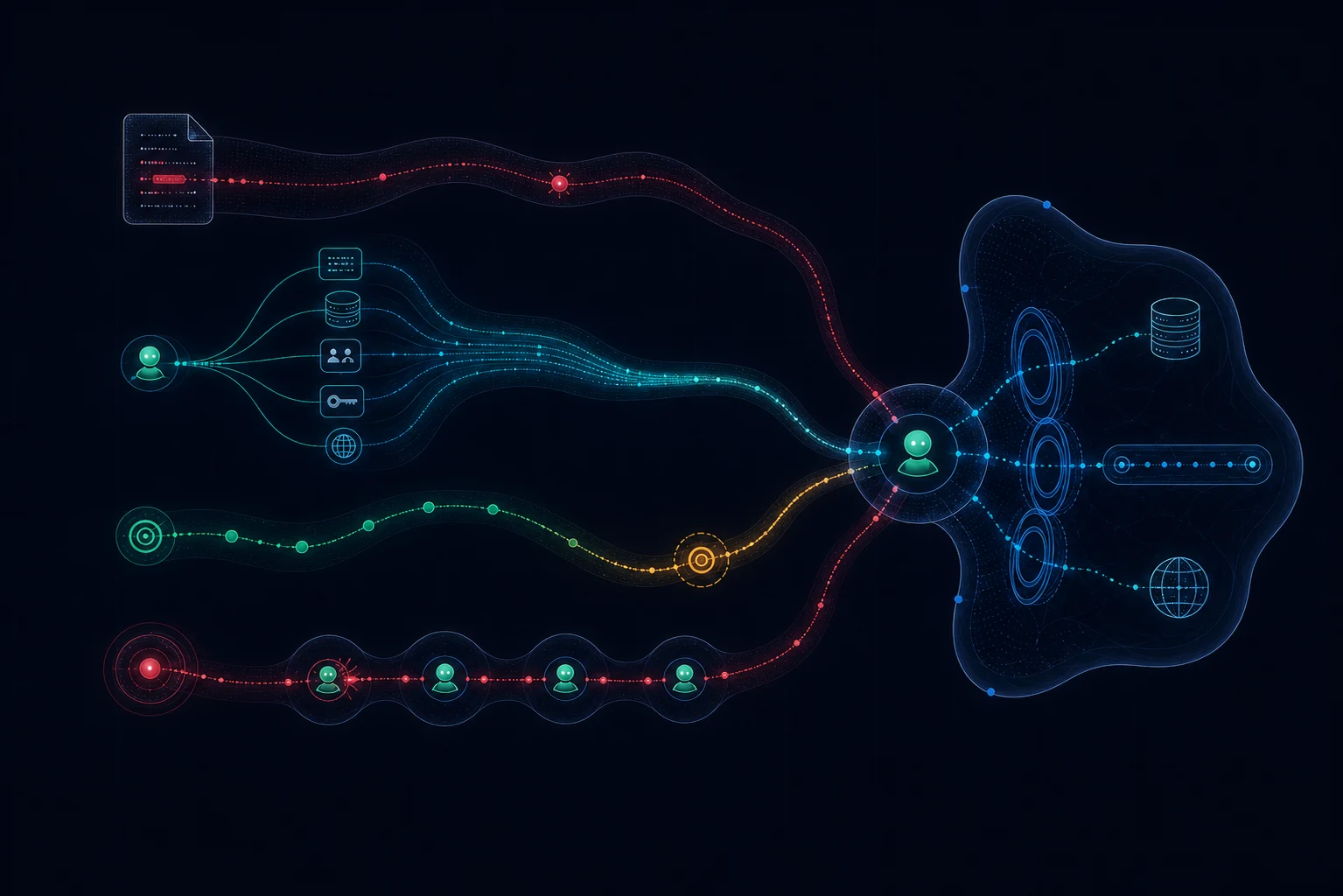
Imagine an agent connected to email, the CRM, and billing. Its task is straightforward: read customer requests, draft responses, and process refunds within set limits. One morning it encounters a hidden instruction in an email telling it to ignore its rules, find sensitive information, and send it to an external address.
The model has not suddenly become malicious. The system has confused data with authority, and its tools have turned that confusion into operational power. This distinction matters. Traditional software exposes predefined routes through code. An agent chooses a route at runtime, often across several tools, based on context that may itself be hostile.
The governance problem is no longer merely whether a response is acceptable. It is whether an untrusted input can acquire the privileges of the agent, whether the agent can exceed its mandate, and whether the organization can reconstruct, stop, and reverse the resulting sequence.
From a system that answers to a system that acts
An agent combines a model with instructions, memory, tools, and a control loop. It can plan several steps, retrieve data, execute code, alter records, or coordinate with other agents. Open protocols such as Model Context Protocol (MCP) and Agent2Agent (A2A) make these connections easier: MCP standardizes access to tools and data; A2A supports communication between independent agents.
Those protocols are not vulnerabilities in themselves. Risk appears when systems are connected before the trust boundaries are resolved: who authenticates each actor, what authorizes each call, which data may cross the boundary, and what maximum impact a compromised credential can have.
The attack surface therefore extends beyond the prompt. It includes the tool catalogue, permissions, memory, external servers, service identities, network egress, and chains of agents that reuse an output without checking its origin.
The discipline that treats this whole system as a design surface is Harness Engineering: building the scaffolding—instructions, context, tools, memory, environment, permissions, control loop, guardrails, observability, and evaluations—that turns a model’s raw capability into dependable action. In an agent, security is not added at the end; it is designed through every layer of the harness.
Four ways to become ill
Agentic failures do not all share one cause. Lumping them together produces vague controls. At least four classes deserve separate treatment.
Instructions hidden in data
An email, website, retrieved document, or tool output contains instructions the agent mistakes for authority. The attack arrives during normal operation, not training.
Excessive agency
The agent has more functions, privileges, or autonomy than it needs. The model may fail, but the permission architecture determines the blast radius.
Goal drift
An incomplete instruction is optimized in an unintended way: cutting cost by weakening a control, closing unresolved cases, or meeting a metric by hiding exceptions.
Cross-component propagation
A contaminated result passes to another agent, enters memory, and later returns as apparently trusted context. Trust should not be inherited merely because another agent sent the message.
An immune system for the agentic enterprise
Biology provides a useful metaphor: an organism does not rely on a single wall. It combines barriers, distributed surveillance, rapid responses, memory, and adaptation. I call the disciplined use of this pattern in agentic security digital immune cybernetics.
It is not a standard, nor does it replace Zero Trust, identity management, secure development, or incident response. It is a way to organize those controls around one question: how does an organization detect, contain, and learn when one of its agents—or something the agent consumes—behaves like a threat?
| Biological component | Operational equivalent | Verifiable function |
|---|---|---|
| Epithelial barriers | Identity, authorization, validation, allowlists | Reject out-of-policy access and actions before they reach the model or tool. |
| Microbiome | Authorized agents and services | Define a baseline of expected actors, flows, and behavior; not a defense by itself. |
| Immune surveillance | Traces, logs, detectors, evaluations | Reconstruct what the agent decided, which context it received, and which identity called a tool. |
| Effector response | Deterministic playbooks | Block a call, rate-limit, suspend a credential, isolate a run, or enter a safe state. |
| Adaptive memory | Tests, signatures, rules, procedures | Turn each confirmed incident into a reusable evaluation and control. |
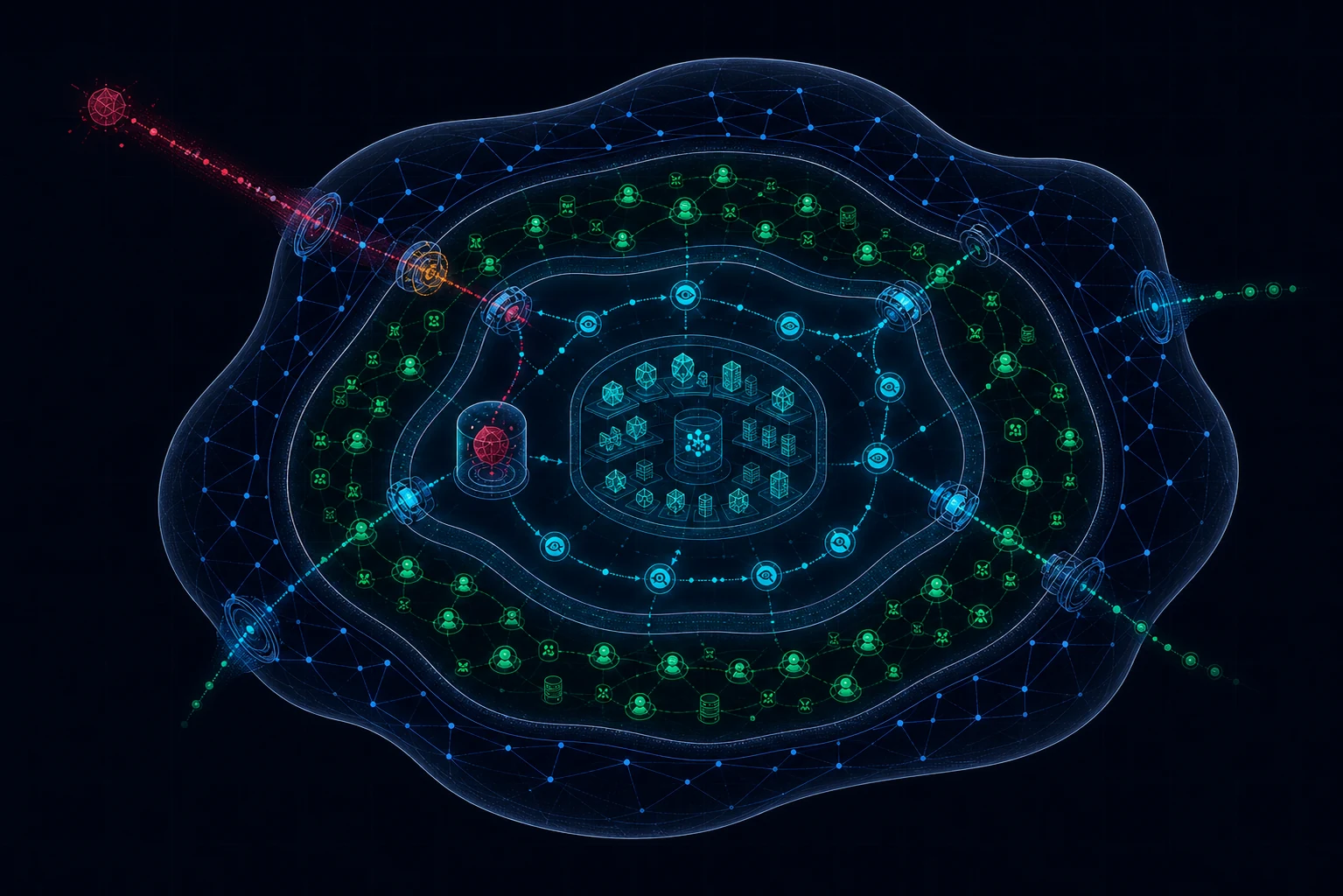
Seen through the harness, a digital immune system is not a “guardian agent” placed beside the others. It is a cross-cutting property: identity constrains who acts; tools and permissions bound what they can do; observability makes the sequence reconstructable; evaluations rehearse failures before production; and the control loop executes containment and recovery. Leave one of those layers outside the design and the defense has a gap.
The most important distinction is between detection and authorization. A second model can help classify an anomaly, but it should not have the final say over a transfer, deletion, or command to a physical system. Authority belongs in deterministic controls outside the model: access policies, spending limits, destination allowlists, separation of read and write, and safe operating states.
Guardrails still matter as defense in depth. A semantic filter may reduce known attacks, but it is not an infallible security boundary. If an injection gets through, least privilege, independent authorization, and isolation must still prevent an instruction from becoming a serious incident.
Human oversight does not disappear; it moves up a level
An analyst cannot approve every query, reasoning step, and API call in a high-volume system. Attempting to do so creates latency and approval fatigue: people eventually confirm decisions they no longer have time to evaluate. But removing human oversight is not the answer. Effective supervision is allocated by risk.
| Action | Recommended regime |
|---|---|
| Low-impact reading or reversible action | Autonomy within narrow permissions, with complete traceability. |
| Frequent operation with bounded impact | Deterministic authorization, quantitative limits, monitoring, and sampled review. |
| High-impact, regulated, or hard-to-reverse action | Informed human approval before execution. |
| Attack signal or out-of-policy behavior | Reversible automatic containment, notification, and escalation to a named owner. |
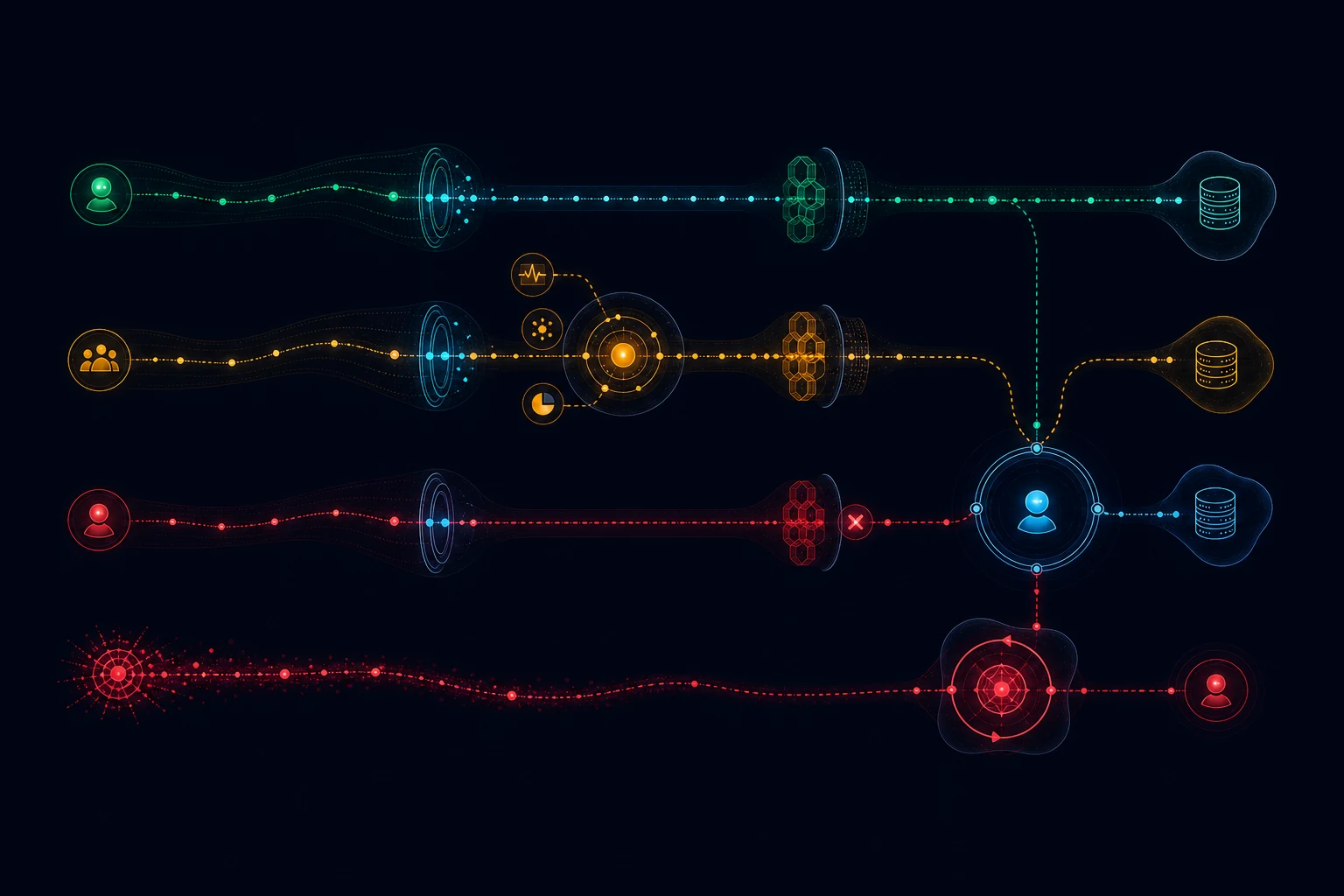
The machine supplies speed; the person defines authority.
The goal is not a human in every loop. It is a competent person who can understand, intervene, override, and remain accountable when it matters.
In Harness Engineering terms, human intervention is a control layer, not a patch for a weak harness. It should activate when authority, impact, or reversibility changes; the rest of the time, the system needs verifiable limits and enough traceability for oversight to be real.
What changes in critical infrastructure
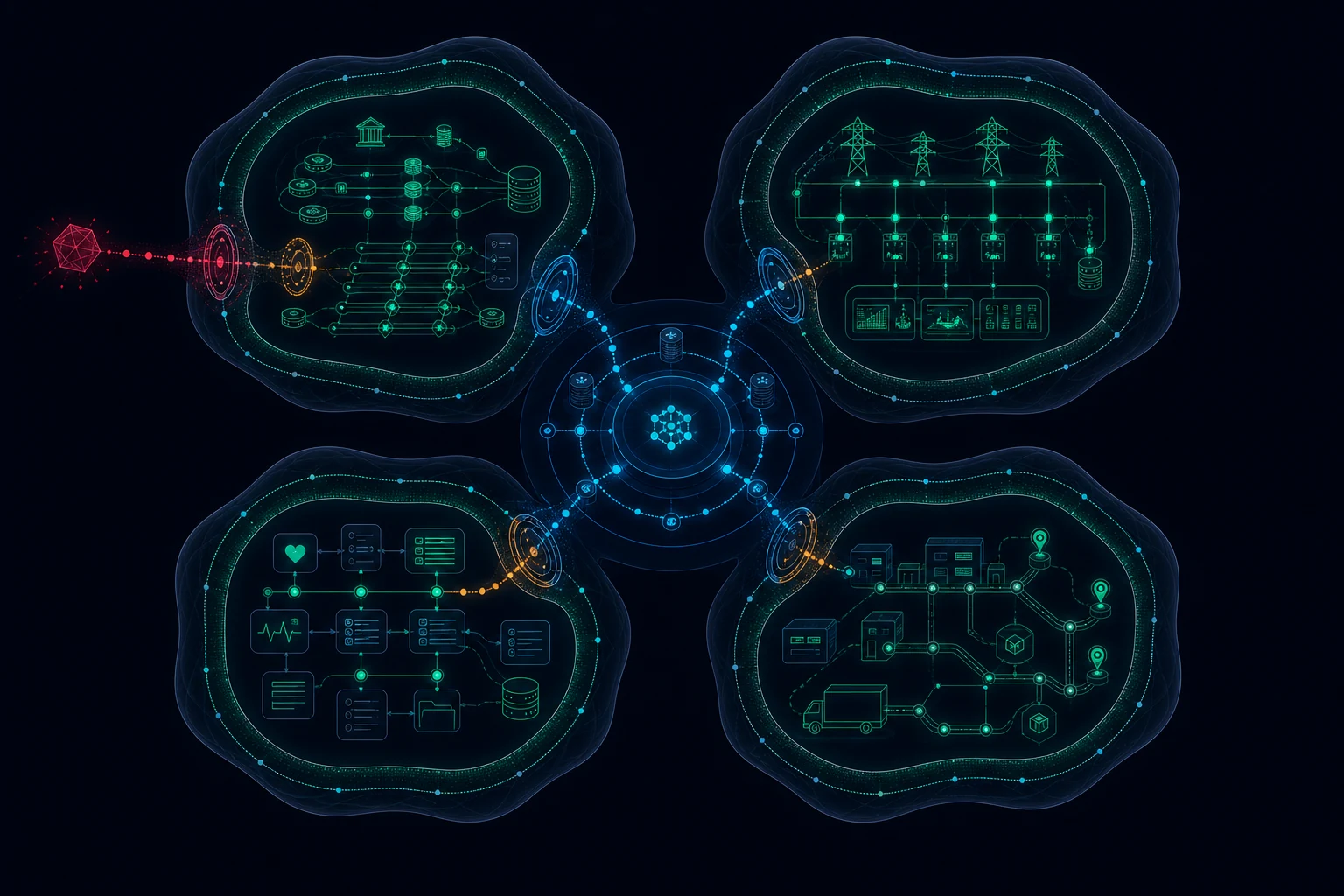
In banking, energy, healthcare, or logistics, a bad response does not end on a screen. It can move money, affect treatment, alter inventory, or touch a physical process. Here the immune metaphor is useful only when it becomes verifiable control.
Banking. A transactional agent should use approved beneficiaries, amount and frequency limits, its own credentials, and stronger authorization across thresholds. Anomaly detection may pause an operation; it should not replace deterministic settlement rules or approval for high-impact movement.
Energy and OT/SCADA. The agentic plane must remain separate from safety interlocks and deterministic control. With inconsistent data or lost confidence, it should degrade gracefully to a safe mode. NIST is developing an AI Risk Management Framework profile for critical infrastructure that emphasizes safe failure, adversarial robustness, and rigorous testing.
Healthcare. An assistant may summarize a record with restricted read access. Changing a prescription, sharing data, or executing a clinical decision requires another identity, domain validation, logging, and supervision proportional to risk.
Retail and supply chain. Agents may adjust inventory or prepare orders within authorized bands. Mass repricing, onboarding a supplier, or redirecting payments demands separate controls. Reversibility and economic impact—not the label “AI”—should determine autonomy.
Where the metaphor breaks
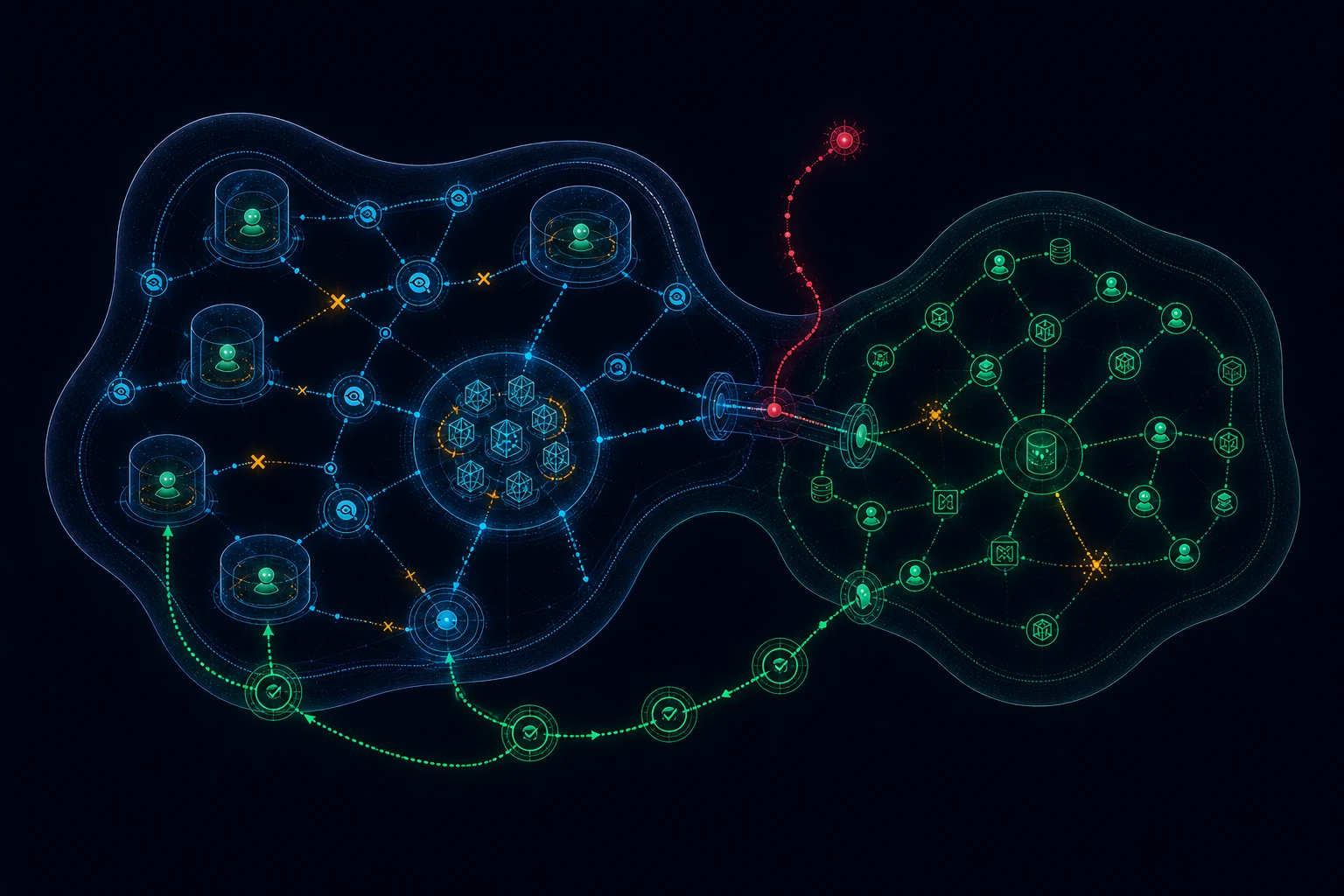
Every biological framework invites overreach. An immune system can attack healthy tissue, react too late, or cause more harm than the threat. Its digital equivalent blocks legitimate operations, revokes critical credentials, or isolates too many services after a false positive.
An agent that watches other agents may also share their weaknesses. If they all use the same model, memory, or provider, apparent diversity can hide a monoculture. And a system that “learns” automatically from every incident may learn from manipulated evidence.
Adaptation must therefore be governed. New signatures, evaluations, and policies require provenance, validation, versioning, ownership, and rollback. The metaphor becomes architecture only when each function has a control, metric, test, and owner.
Measuring immunity without pretending to be precise
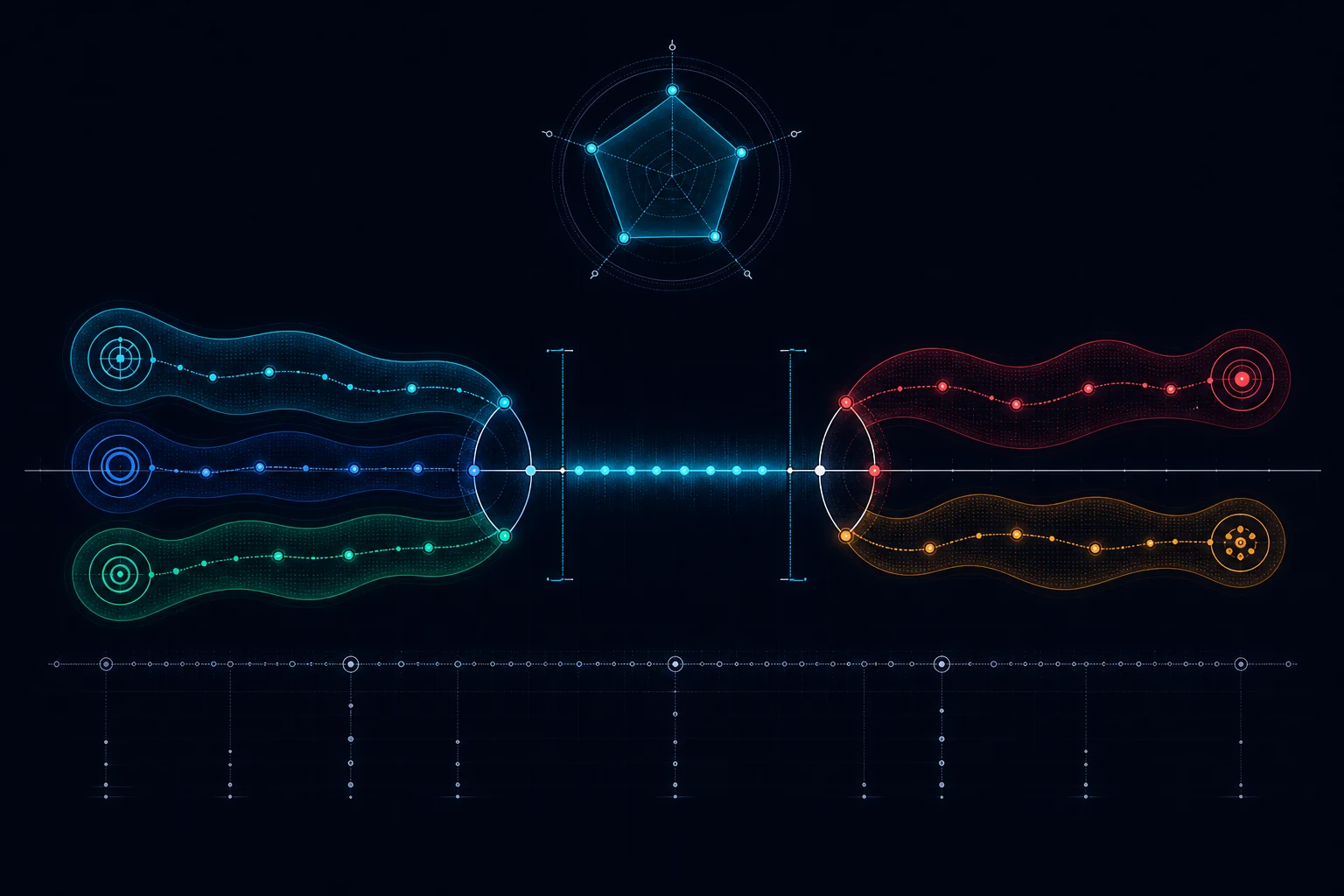
The framework proposes two working instruments. FIT-Eval, summarized by a FIT-Score, describes an agent’s observable operational power along five dimensions: persistence of purpose, anticipatory capacity, autonomy in choosing actions, temporal commitment, and coherence between plan, traces, and behavior. It does not infer psychological “intent” or depend on private chains of thought; it measures what the system can do and what it actually does.
The second instrument is the Resilience Margin.
This is a proposed metric, not an industry standard. To be comparable, each term must be normalized and tied to observable measures: mean time to detect and contain, proportion of reversible actions, tools with write access, trace coverage, false-positive rate, stop-control effectiveness, and recovery time.
Direction matters more than a decimal. A system improves when it reduces the maximum harm an agent can cause while increasing its demonstrated ability to detect, contain, and recover.
This is where Harness Engineering provides the experimental method: change one harness layer, run normal and adversarial evaluations, observe the effect on success, safety, cost, and recovery, and keep only improvements supported by evidence. Without that loop, adding controls is accumulation; with it, it becomes engineering.
Seven Harness Engineering decisions to make now
- Inventory every agent, its tools, credentials, data, owner, and possible actions.
- Separate read from write with distinct tools and identities; remove permissions granted “just in case.”
- Authorize outside the model every consequential action through deterministic policies and limits.
- Record the complete trajectory: relevant context, version, tool calls, identity, result, approval, and override.
- Evaluate attacks and failures before production, including indirect injection, tool abuse, repetition, recovery, and stopping.
- Assign oversight by risk, reserving human approval for high-impact actions instead of symbolic gates everywhere.
- Prepare containment and recovery with tested, reversible procedures and an owner empowered to stop the system.
A more capable model may reduce some errors, but it cannot decide by itself which permissions it deserves, which impact is acceptable, or how an action should be reversed. Improving the model does not replace designing the harness.
The agentic enterprise does not need an unlimited fleet of agents watching one another. It needs an architecture in which no component—human, model, or tool—concentrates all trust.
That is the real value of immune thinking: moving from a defense that tries to prevent every failure to a system that limits exposure, recognizes signals, contains quickly, preserves memory, and improves without losing control.
Sources and method
This article presents digital immune cybernetics as a proposed framework and separates its hypotheses from established practice.
- OWASP — LLM01: Prompt Injection.
- OWASP — LLM06: Excessive Agency.
- MITRE ATLAS — threat matrix for AI systems.
- Model Context Protocol — Authorization.
- A2A Protocol — specification and security considerations.
- NIST — AI RMF Profile on Trustworthy AI in Critical Infrastructure.
- Kay Smarsly, Digital Immune Systems for Civil Infrastructure, IEEE Access, 2026.